
What Craft-Design Thinking Actually Means

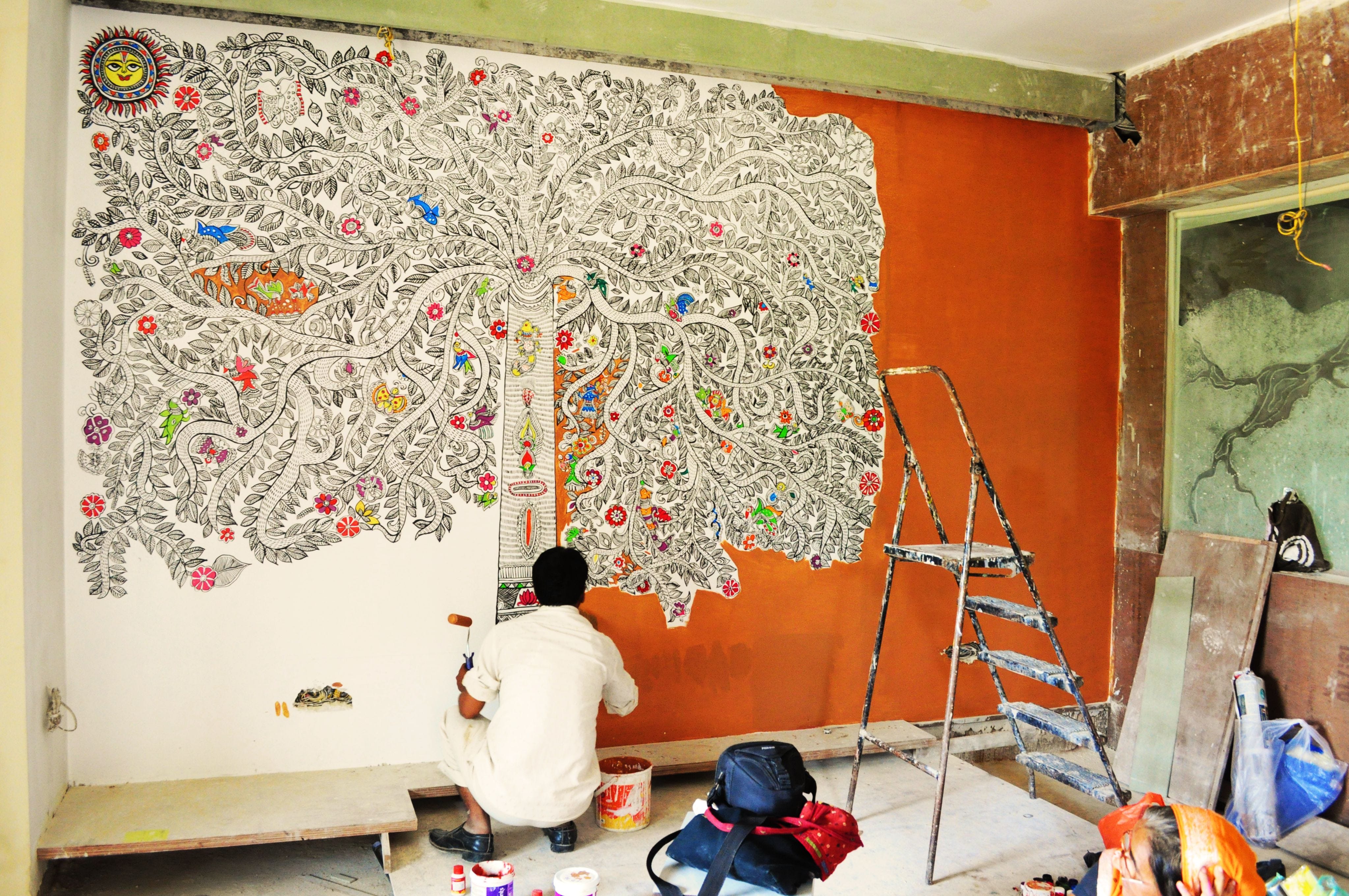
The first project I ever made involved a Madhubani tree of life on a terracotta background.
I got the artisan to paint the tree first, then the background around it. I had a composition in mind. A visual outcome. I knew what I wanted it to look like and I asked the artisans to produce it.
The artisan was mighty irritated with me.
Madhubani painting is so dense that it is maddening to paint the background at the end. You paint the background solid colour first. Always. This is not a preference or a habit or a stylistic convention. It is the order of operations that the tradition has worked out over generations, it is the sequence in which a surface is built, the hierarchy of what goes down first and what follows. I didn’t know this because nobody had taught it to me. I hadn’t thought to ask. I had looked at Madhubani paintings and seen a visual language. I had not looked for the grammar underneath it.
I learned it with aching shoulders, helping a frustrated mother-son team paint into the tiny gaps between very dense branches that I had asked them to paint first, in the wrong order, on a surface that now had no room for the background the tradition needed to lay down before anything else.
That was the moment I understood the difference between using a craft and thinking in one.
Using a craft means bringing your own design logic and asking the tradition to execute it. You decide the composition, the palette, the subject, the scale. The artisan delivers. The result looks like craft. It is not craft-led.
Thinking in craft means letting the tradition’s own logic shape the decisions. The order of operations. The spatial grammar. The hierarchy of what gets made first, what gets placed where, what the tradition knows about how a surface or a space should be built.
The distinction sounds subtle. It is not. It is the difference between a space that has craft applied to it and a space that could not have been made any other way.
Most design education in India and I have taught at CEPT and run workshops at NID, so I am speaking from inside this system teaches the first approach without knowing it is doing so. Students are taught to research traditions, to document motifs, to understand cultural context. They are taught to appreciate craft. They are not taught to think in it.
The result is a consistent and almost universal mistake: students extract the aesthetic and leave the knowledge behind.
They take the pattern. They take the colour palette. They take the texture and the warmth and the sense of the handmade. They bring these things into their design work and produce something that looks like it is in conversation with a craft tradition. It is not. It is wearing the tradition’s clothes.
What they leave behind is the order of operations. The material logic. The structural solutions that the tradition developed over centuries in response to specific problems; problems of dye behaviour, of scale, of the body’s reach, of how a surface holds pigment, of how a form carries meaning in a specific community’s visual vocabulary. The knowledge that lives not in the motifs but in the sequence. Not in the image but in the making.
I have watched students encounter a craft tradition for the first time and immediately begin to think about how to use it. Which elements are extractable. Which motifs could work in a contemporary context. How the colour palette might translate.
The question they almost never ask first is: what problem was this tradition solving?
Every major craft tradition in India is a body of accumulated solutions. Mata Ni Pachedi’s dense patterning exists because hand-dyeing large areas with vegetable pigments produces uneven colour, the pattern hides the dye variation. Sanjhi’s compositions are structured around the handspan because the cutting tool loses precision beyond the reach of one arm. Gond painting’s horizontal banding records where one reach ended and the next began. The tradition absorbed the limit and made it grammar.
These are not aesthetic decisions. They are engineering decisions that became aesthetic over generations of practice. When a student looks at them and sees only the aesthetic, they have seen the surface of the tradition and missed the tradition entirely.
What craft-design thinking requires, before anything else, is the willingness to ask why. Not why in the philosophical sense, but why does this tradition exist, what does it mean culturally. Why in the material sense and why does this line stop here, why does this area stay dense, why does this form always appear in this sequence. The answers to those questions are where the tradition’s intelligence lives.
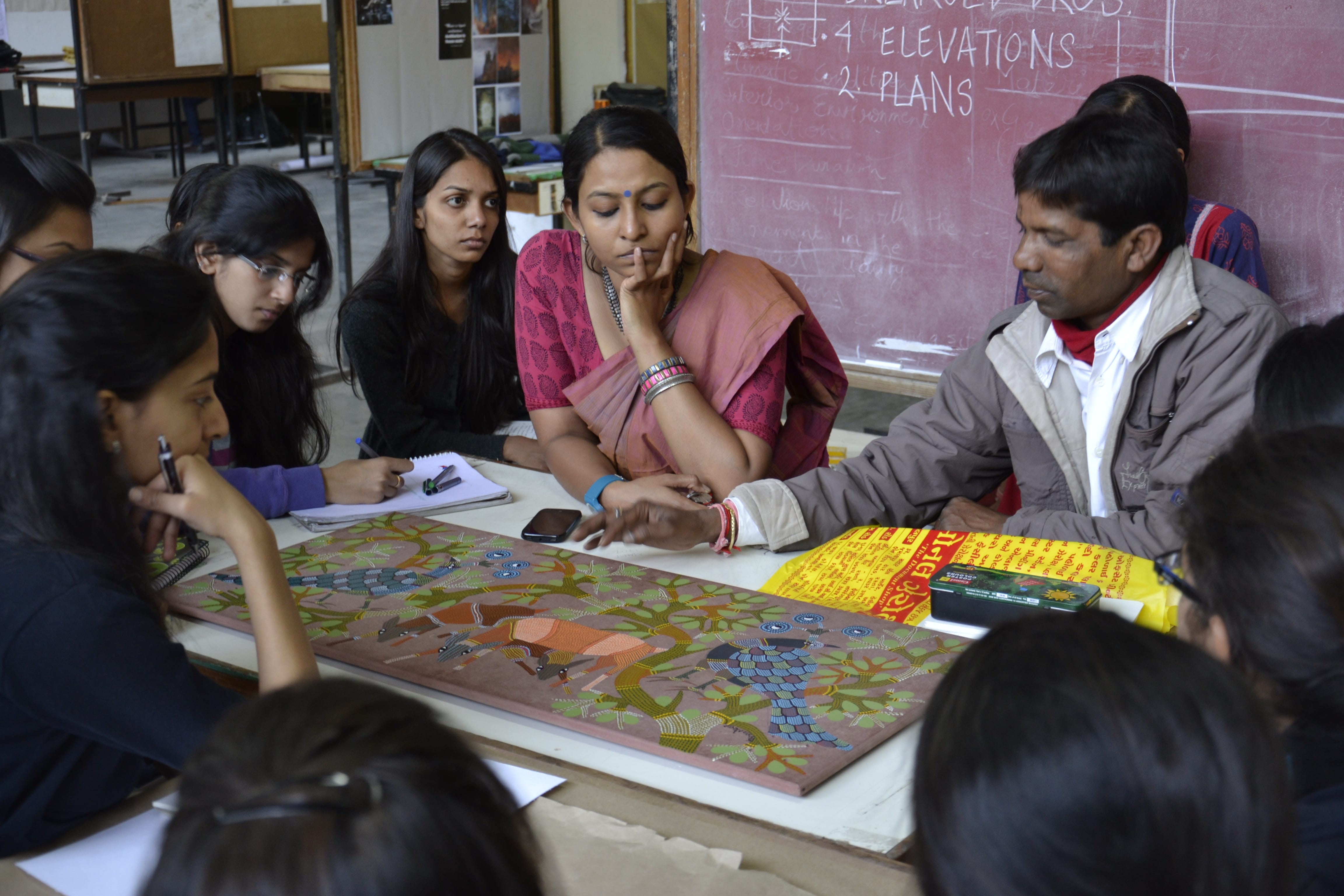
I have been thinking about what design education in India would look like if craft-design thinking were genuinely central to it. Not a module or an elective on indigenous practices or a field visit that produces a sketchbook of documentation. But more structural. Present from the first year, running through every studio, shaping how students are taught to begin a design problem.
The change would not primarily be in the curriculum. It would be in the question students are trained to ask first.
Currently, the first question in most design education is: what should this look like? The second question is: how should it work? Craft-design thinking asks a different first question: what does this material or tradition already know about this problem?
That shift ,from what should I make to what does this tradition already know would change everything downstream.
Students trained to ask that question first would arrive at briefs differently. They would sit with artisans differently, not as documenters or collaborators in the production sense, but as apprentices to a body of knowledge that they do not yet have and cannot acquire quickly. They would understand that the time craft takes is not inefficiency. It is the knowledge transfer itself. You cannot learn the order of operations from a manual. You learn it by doing it in the wrong order once and understanding what went wrong.
If Indian design education were built on that foundation, Indian design would look different.
Not different in the sense of more traditional, or more decorated, or more visibly connected to heritage. Different in a deeper sense: more Indian in its thinking, not just in its appearance.
Our buildings would respect our weather as a logic that shaped the brief from the beginning, the way indigenous architecture has always done. Our public spaces would carry our performing arts not as events existed in the past but as a seamless part of current popular culture because a designer who has thought in craft understands how to translate the craft in any context. Our interiors would look like how they were supposed to look here where we live and not as replicas from another country.
We have craft traditions that solved problems of climate, of community, of the human body’s relationship to space and surface and material, that design schools are still trying to solve from first principles using Western frameworks. The solutions already exist. They are in the hands of artisans in Dindori and Mathura and Kutch and Mithila and Spiti. They have never been written down because they never needed to be written down. They lived in the room between a master and the person standing next to them.
Design education that took craft-design thinking seriously would put students in that room. Not to extract the motifs. To learn what the room contains.
That is not a return to tradition. It is the most contemporary thing Indian design could do.